

Subteam Information
The Payload subteam is responsible for designing, building, and testing the scientific payload that fits within the constraints of the SDL payload challenge.
Payload Team Lead: Florenzo Cruz-Garbo


General Overview
The Payload subteam’s main goal is to design, test, and build the payload component of the high-powered subscale and full-scale rocket for the annual IREC Competition. The team aims to base the payload around an interesting scientific experiment that fits within the constraints of our rocket’s design. This is done through multiple processes and encourages creativity in the design of our rocket and payload. The payload is an essential part of our competition process, as without a functioning payload, there's no point in launching the rocket.
SDL Payload Challenge
We participate in the SDL Payload Challenge, which is a separate competition from the main IREC competition. The challenge is organized by Utah State University, and its goal is to inspire, educate, and engage tomorrow’s workforce through a variety of real-life, hands-on experiences. The university sponsors the payload component of the competition, encouraging teams to develop a scientific payload that performs a relevant function and provides valuable learning opportunities. This challenge is an important part of our team's design and engineering process.


Current/Past Payloads
One of the challenges for this subteam is the creativity required to develop a new payload each year. This year, the team is building a High Altitude Atmospheric Bacterial Sampling device. The device will filter a large volume of air to capture bacteria and other microbes that live above 25,000 feet, and will analyze gases and other atmospheric data. In the past, our payloads have included observing fluid behavior in microgravity, observing X-rays to determine their origin, creating and comparing custom pitot tubes with GPS data, and deploying a muon detector.
Current Projects
This year, the experiment we are building is a High Altitude Atmospheric Bacterial Sampling device. The device will filter a large volume of air using a high-RPM fan to capture bacteria and other microbes that live above 25,000 feet, using a 0.45-micron filter. This filter will be sealed and sampled to see the microbes. In addition, it will sample the atmosphere from sea level to 35,000 feet, looking for multiple gases, including oxygen, carbon dioxide, and methane. The payload will require multiple gas sensors to detect these gases, including the Adafruit BME680, Grove MQ9, and MG811 Gas Sensors.
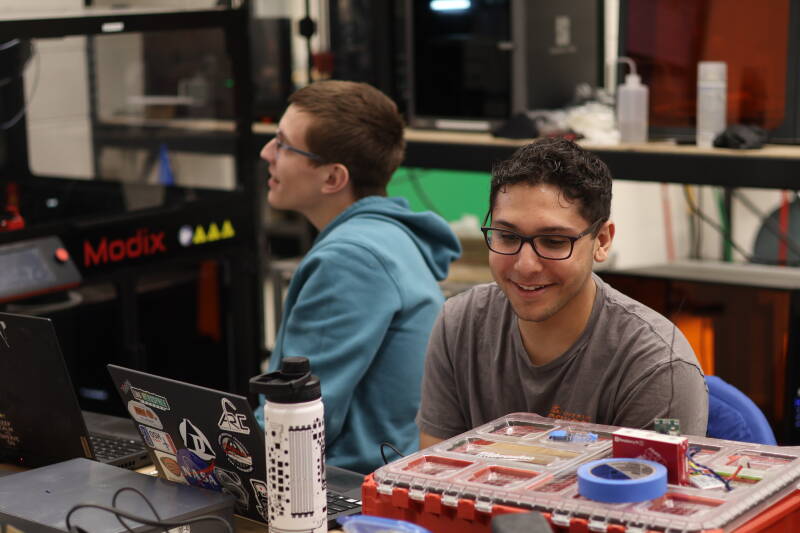
Currently, the team is completing the design phase for the full-scale payload and determining which tests can be conducted during the subscale launch. Since the sub-scale rocket is smaller than the full-scale rocket, the team must determine which components of the finalized payload to test. Additionally, the team is working to gather components for the final payload. Some parts must be purchased online (such as the fan and gas sensors) because they are too complex to manufacture in-house. Other parts will be designed in CAD and then 3D-printed.