

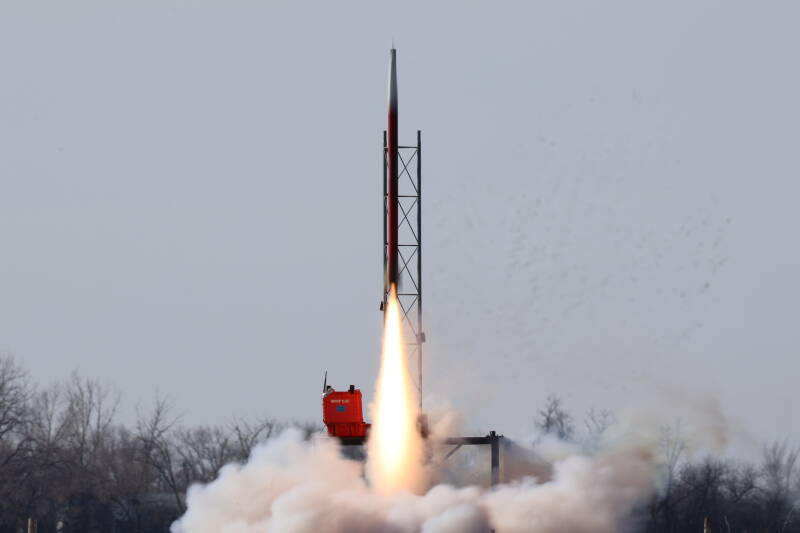
On Sunday, February 8th, the Advanced Rocketry Club launched their annual IREC Subscale Rocket, gaining a better idea of what their full-scale design will demand and making many adjustments as they begin working on it. Overall, the sub-scale launch satisfied the club members and achieved some of the goals they had set.
“The overall flight of the rocket went really well,” said Airframe Subteam Lead Nicci Dame, “we reached just shy of 11,000 feet, and just shy of Mach 1, which is what we were aiming for.” The members also appreciated the rocket's condition after the launch.
“The recovery, I'd say, was the next best thing,” said Dame, “the rocket was close by, so we were able to only look for about 15 minutes, and we found it sitting out in a field. Nothing was damaged, and nothing was missing.”
Despite the success of the launch and what the team learned from the data they collected, the club still ran into some difficulties before the launch.

“The airframe subteam ran into a slight hiccup right before the subscale launch. There was an accident with the manufacturing that had happened a few days prior that threw off the overall timeline of having the rocket done on Thursday night,” said Dame. “It made things slightly difficult on the day of the launch because that meant right before we were getting ready to go out and launch, we were still in here doing finishing touches on the rocket, which is not what we want.”
After rushing to fix the airframe issues, members also faced a new challenge: packing the parachutes into the subscale rocket. “It was really, really tough to try to get those into the rocket and close it back up,” said Anton Golokvo, the IREC Competition Chief.
Though the amount of space the parachutes took up and the issues with fin manufacturing were unexpected, the team went right to work to fix the issues with the full-scale rocket by adjusting its design and length.
“The space claim with the parachutes really influenced the full-scale design,” said Dame. “We’ve added quite a bit of length to the overall full-scale design as a result of that. We added four inches to the upper body and two inches to the lower body to make more room for those parachutes.”
The launch provided an opportunity for members to improve the design of the full-scale rocket, including adjustments to the payload.
“I learned around what the practical max weight for the payload would be,” said Payload Subteam Lead Henry Zeimet. “Due to the subscale launch, we’ve been changing some stuff with the structure. Initially, we planned to use a plastic frame, but now we’re using an aluminum frame to make it more structurally sound because it's going to be placed at a joint between sections of the body.”

Post-launch, the club also recognized patterns from last year’s subscale launch that correlate with this year’s, posing another challenge for the team to tackle.
“Last year, we noticed on the subscale that we had some scorching on the lower rail guide, and we haven’t quite nailed down why that happens yet,” said Dame, “But we did notice that it happened again on this subscale rocket. We think it has something to do with just reaching that transonic region where you are going from Mach 0.7 to Mach 1, we think that it happens there.”

The subscale launch gave ARC a great opportunity to further evolve the full-scale design and inspect every detail they need to develop. The work on the full-scale design is now in full swing, each member passionately devoting greater time to completing their projects.
“Each sub-team is meeting every single week. We also have build days on each Saturday, and we try to work on components and try to do different testing so that our systems will work out,” said Golovko.
The team’s dedication has already yielded further progress on the rocket, with multiple facets of its full-scale design underway.
“I’m mainly focusing on the CAD modeling of the full payload. We’re working on the airflow structure, which includes the intake and the exhaust manifolds, the valves, the filter design, the battery pack, and where the Raspberry Pi is going to be mounted,” said Zeimet. “The frame is almost completely done.”
The club continues to gain momentum each week as they finish the full-scale rocket’s design phase and transition into the manufacturing phase of the project.
Author: Anya Unser


Add comment
Comments